image by sarah mccoy photo

Sunday, June 17, 2012

Astroturf Gardening

Cookie and I were on a fabulous adventure the other night, eating 50/50 burgers, of which half the meat is ground bacon, in a restaurant with the kids at 9pm.  While we were enjoying their happy-tired delirium and our garlic aioli, the lady at the next table expressed to her partner her surprise that anyone at all would want to have children.

This was odd because our kids were actually being pretty good, but more so because she was seated about 20 inches away from Cookie.

Have you ever heard this sort of enlightened condescension about either married or family life?  I know we in the married-with-children camp do our share of inexcusable condescending too, but I’m thinking now only of a particular brand of “I’ve transcended tradition and built a blithe world of Me.”  When I am confronted with this strain of modernity, I am struck less by offense than something between amusement and pity, and much harder to describe. 

Like how no argument could convince that girl that missing easy evenings out without the hassle of babysitters or making permanent, sacrificial adjustments to accommodate a spouse are to me what $200 dollars for Jimmy Choos might be to her, except that I will still find my purchase fashionable come fall.  But I think I’ve thought of a way to illustrate, at least to myself, our mutual lack of understanding.

It’s like a gardener who, spying around him neighbors covered in dirt and sweat and laboring endlessly, thought, “I won’t be such a fool!” and set about covering his plot of earth with Astroturf.  He filled pots and beds with silk flowers and gazed about in satisfaction, then leaned back in a hammock with a pina colada, and applauded his ingenuity, imagining the envy of his neighbors.

The other gardeners looked up, each in turn as they paused from their work, and noticed the spray of color and their neighbor in repose.  Then, each in his turn went back to his work of tilling and planting, watering and pruning.  The gardener in his hammock was mildly surprised that the others failed to follow in his pursuit of solitary pleasure.  And his neighbors were mildly surprised that he would content himself with pigmented silk when the fruits of their labors were sweet and living.

Tuesday, May 29, 2012

Climbing Parnassus: The Meaning of Education


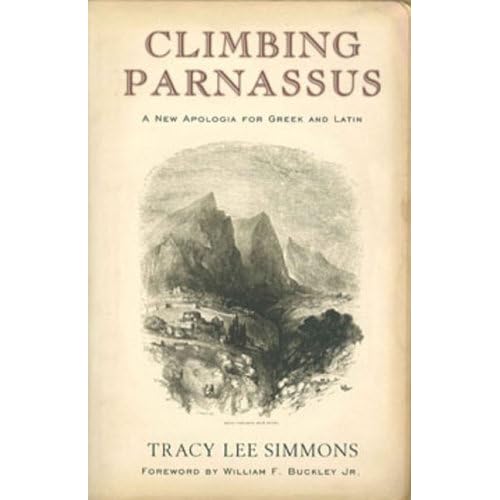
There's so much to say about Climbing Parnassus by Tracy Lee Simmons that instead of reviewing, I'm going to write several spinoff posts.  Be advised, I have three planned so far and I'm only halfway through the book.  The quotability starts right in the introduction.

Now, once upon a time I puzzled upon learning that the Italian verb educare is a false cognate for the English to educate.  In America one is educated if he's been to college.  In Italian, a person is educato if he's well-behaved.  If he goes to school, he's istruito: instructed.  Being egocentric and not having researched the matter, I thought they'd just wandered in their usage.

But no, that was us.
 
Simmons writes of education for the ancients, "...among those gifts most sought was the civilizing, cultivating boon of eloquence, of right and beautiful expression."  In other words, learning served the higher purpose of refining, civilizing, the individual.  Classical learning seeks to develop character, integrity, the inner person first.

In contrast, we tend now to treat these aims as secondary at best.  We hope they'll come on their own, but we have to devote our time and resources to the kind of instruction that correlates directly with making money.  We shape careers more than people.

Simmons writes, "Many people today, without admitting it, prefer training to education, and they must have their heart's desire."

"Ah!" thought I.  False cognate, indeed!  Our word reflects our diminished view of education.  Italy, whatever its schooling system or philosophy, clings to a linguistic vestige of a deeper, less pragmatic vision.

Tuesday, April 17, 2012

Happily Ever After: By Hook or By Crook

Know what I think?  One of the most insidious lies a person can believe is that a soul mate, a one true match, exists.

I know this is a romantic notion on which the hopes of many are pinned, and I’m busting it up.  But only because I think there’s something much, much better.  And you have to give up the romantic notion to get the goods.

The problems with believing in soul mates are many.

1. Believing in soul mates means you could make the wrong choice the first time around.

If you think your significant other is your magical, cosmic match, but then you meet someone who sets your heart aflutter even MORE, you now have a real problem.  Did you marry the wrong guy?  If so, are you perfectly justified in pursuing this new love, due to its even more magical, cosmic nature?  How can you ever be sure—and how long should you hold out?

Conversely, I can be content, like big-time, in marriage not because I think there aren’t any guys out there in the universe equally or better suited to me, but because I know there probably are.  And it’s totally irrelevant to my marital bliss.  If I don’t believe in soul mates, I don't set myself up for the shock of an exciting new someone’s appearance.  Which leaves me free to be happy forever right where I am.

2. Believing in soul mates means you leave the work to chemistry, forgetting that chemistry IS the work.


I think your odds of happiness with a spouse are almost (almost!) unconnected to the particular qualities of that person.  This is super unromantic, yes?  Of course it’s great to choose a person with whom you have something in common and all.  It’s likely that’s what first attracted you anyway.  But it’s not essential to your ultimate happiness.

What is essential is that both of you work to secure not your own interests, but those of your spouse.  Even if you love extreme dirt bike racing and he prefers a quiet read on the patio, you can each prioritize finding ways to make the other feel understood and appreciated.  Loving overtures yield loving feelings over the long term, and not the other way around.  Good looks, common interests and sparkling charisma may win you over initially, but only this love-legwork creates a future. 

(Don’t panic. The work is often fun and usually pays well.)

3. Believing in soul mates means you put too much stock in butterflies.

Butterflies are not the best part.  Butterflies are NOT the best part.  So don’t read so much into them.  Enjoy them, but expect even more. 

Ever walk by a newly landscaped lawn?  It’s grabs your attention; the lines are sharp and the colors vibrant.  But the plants are spaced out to accommodate future growth, so its potential is yet to be realized.  If it’s left to grow unattended, no brilliance of design or quality of materials will keep it from becoming a wilderness.  But if it’s cared for, fed, watered, pruned, in a few years even a garden full of discount nursery castoffs will be spectacular. 

I like butterflies and romance as much as the next girl.  But I’m most dazzled by assurances: that the right formula of work and commitment (and prayer) can weather what comes.  Maybe soul mates do exist.  But they’re made, not found.